How Neural is a Neural Foundation Model?
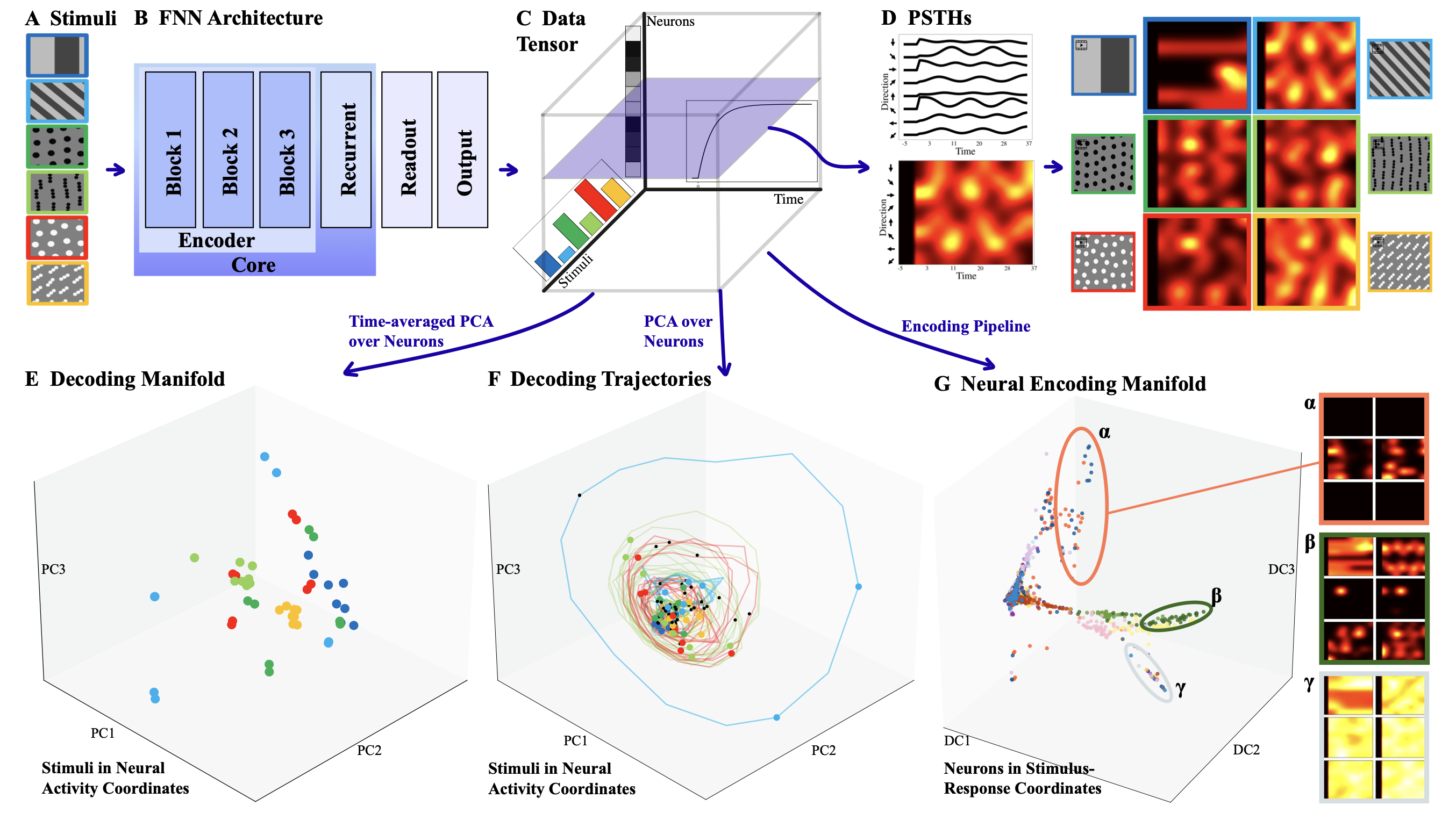 We “peek inside” a neural foundation model like a physiologist – mapping temporal response properties, encoding/decoding manifolds, and introducing a tubularity metric to assess biological plausibility.
Foundation models have shown remarkable success in fitting biological visual systems; however, their black-box nature inherently limits their utility for under- standing brain function. Here, we peek inside a SOTA foundation model of neural activity (Wang et al., 2025) as a physiologist might, characterizing each ‘neuron’ based on its temporal response properties to parametric stimuli. We analyze how different stimuli are represented in neural activity space by building decoding man- ifolds, and we analyze how different neurons are represented in stimulus-response space by building neural encoding manifolds. We find that the different processing stages of the model (i.e., the feedforward encoder, recurrent, and readout modules) each exhibit qualitatively different representational structures in these manifolds. The recurrent module shows a jump in capabilities over the encoder module by “pushing apart” the representations of different temporal stimulus patterns. Our “tubularity” metric quantifies this stimulus-dependent development of neural activ- ity as biologically plausible. The readout module achieves high fidelity by using numerous specialized feature maps rather than biologically plausible mechanisms. Overall, this study provides a window into the inner workings of a prominent neural foundation model, gaining insights into the biological relevance of its internals through the novel analysis of its neurons’ joint temporal response patterns. Our findings suggest design changes that could bring neural foundation models into closer alignment with biological systems: introducing recurrence in early encoder stages, and constraining features in the readout module.
J. Bertram, L. Dyballa, T. Anderson Keller, S. Kinger, S. W. Zucker
Accepted at Data on the Brain and Mind @ NeurIPS 2025 (Workshop)
Paper: https://openreview.net/forum?id=jUy7vFgoZf Under Review at ICML ‘26